When landlords ask me about the Renters’ Rights Act, the conversation usually starts with “what do I do now Section 21 is gone”. That makes sense, since it’s in all the headlines. But the part you’ll notice week to week is rent, from how you advertise it through to how you put it up.
These new rules came into force on 1st May 2026, so they apply to you now if you’re a private residential landlord in England. A few of them catch out careful, experienced landlords, because they undo habits most of us have had for years. A CPI clause in the tenancy agreement, or an email stating that the rent is going up £25 a month. Neither of those can be used any more.
The advertised rent is now your ceiling
Any listing for your property now must state a specific rent. A price range isn’t allowed, and neither is inviting “offers over”. Portal listings such as Rightmove, social media posts and emails all count, the only area that doesn’t is a “To Let” board.
Once that figure is out there, you can’t ask for, encourage or accept offers above it. That includes an applicant who offers more off their own back, and it includes telling people you’ve had other offers. However, you can still accept an offer below the advertised rent.
Your local council are now the ones that enforce this, as stated on the GOV.UK Guide to the Renters’ Rights Act, a first breach can mean a fine of up to £7,000. If an agent markets the property for you, the same rules apply to them, so it’s worth asking how they now handle a property with lots of interest.
There’s another reason to take care over the asking rent. Tenants can ask the First-tier Tribunal to decide the open market rent within the first six months of a tenancy, with the test now simply being whether your proposed rent is above the market value. Be sure to keep a record of how you or your agent reached your proposed rent, with a few comparable lets nearby and a record of the property’s condition at the time of publishing.
Rent in advanceNo rent before the agreement is signed
You can’t ask for or take any rent until you and the tenant have entered into the tenancy agreement. Taking the first month’s rent at the same time as a holding deposit, before anything is signed, now counts as a prohibited payment under the Tenant Fees Act.
Between signing and move-in, you can ask for up to one month’s rent. Once the tenancy has started, any term requiring rent to be paid before its due date can’t be enforced.
A tenant can still choose to pay ahead if they want to. You just can’t make it a condition. If you’ve relied on larger upfront payments, for example with student lets, this is the change to plan around. Councils can order a prohibited payment to be repaid and issue a civil penalty of up to £5,000.
Tenancies agreed before 1st May 2026 are treated differently on some of these points, so check the GOV.UK guidance if you have older agreements running.
Rent increasesSection 13 and Form 4A are now the only route for a private rent increase
If you want to put the rent up on an existing tenancy, there is now one way to do it: serve a Section 13 notice on Form 4A, which can be found on the GOV.UK website.
For the notice to be valid, you need to give at least two months’ notice (it used to be one month for most tenancies), and the new rent has to start at the beginning of a rent period. You can only increase the rent once a year: not within 52 weeks of the last increase, and not in the first year of the tenancy. The form needs to be the current one, with your tenant’s details correct, and signed by you or on your behalf by your agent.
This also means you can’t agree a new rent informally, even when your tenant is happy with it. GOV.UK is clear that you must follow the Section 13 process every time, including when you’ve already agreed the increase. A friendly conversation first is still a good idea. It just needs a Form 4A behind it.
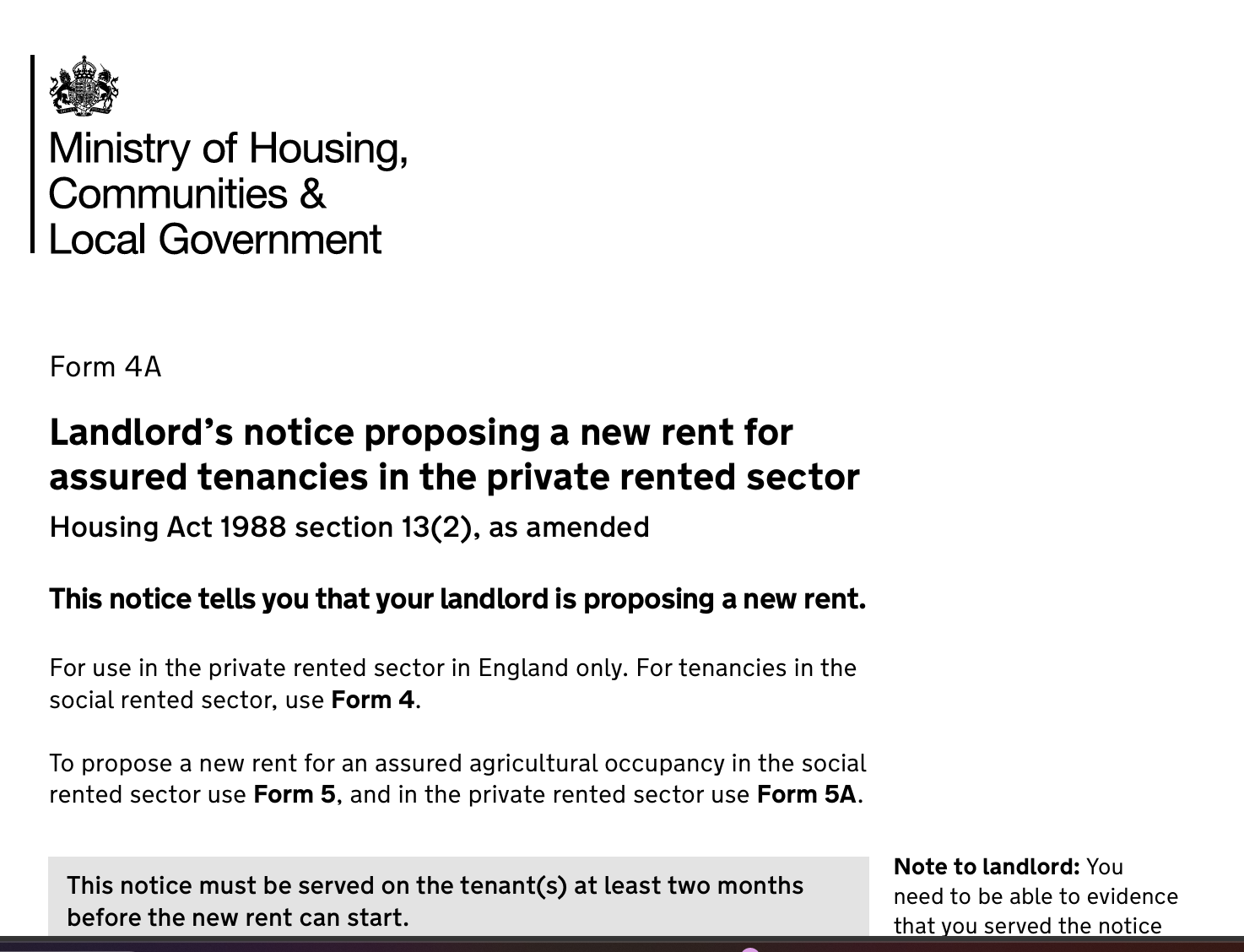 Form 4A, the only route to a rent increase on an assured periodic tenancy. Download the current version from GOV.UK.
Rent review clauses no longer work
Whether it was linked to CPI or set at a fixed percentage, any clause that put the rent up automatically stopped working on 1st May 2026. That applies to existing agreements as well as new ones. The GOV.UK website also confirms that an increase agreed under a review clause before 1st May 2026, but due to take effect after it, isn’t permitted.
If your template agreement still has one, take it out or find a new template. Leaving it in won’t raise the rent, and it could confuse your tenant about what they actually owe.
Tribunal challengesTenants can challenge any increase, with less to lose
Your tenant can now refer any Section 13 increase to the First-tier Tribunal, as long as they apply before the new rent is due to start. The application fee is £47. The tribunal decides the open market rent for the property, and it can now only keep your proposed figure or lower it. It can’t set a rent higher than the one on your Form 4A, which was the main risk for tenants under the old rules.
Before you serve